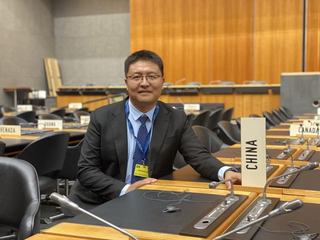
 Mao Weizhun 所在系: 研究室: 职务/职称: 联系电话: 学位:PhD 2012, Dr. rer. soc 2015 电子邮件:wzhmao@nju.edu.cn 研究领域:
个人简介
开设课程
A Study on Constructing China’s International Responsibility System from the Vision of a Community of Shared Future for Mankind,General Research Project 2018 by National Social Science Foundation (Grant No.: 18BGJ033). An Exploratory Study on the Role of Jiangsu Province in the Protecting China’s Over- seas Interests, Junior Research Project 2016 by Jiangsu National Social Science Founda- tion (Grant No.: 16ZZC002). History, Situation and Future of Asia-Pacific Regional Cooperation, Project of Coun- tries and Region Studies 2017-2018, Ministry of Education of the People’s Republic of China Aid Security: A Comparative Framework, Project 2016 of The Dr. Seaker Chan Center for Comparative Political Development Studies, Fudan University (Grant No.: CCPDS- FudanNDKT16011). The Significance of Great Reversal: From Globalization Backfire to Rebuilding Global Order, Project 2017-2018 of The Dr. Seaker Chan Center for Comparative Political Development Studies, Fudan University (Grant No.: CCPDS-FudanNDKT18016). A Study on Reform of Political Education and Teaching in US and European Universi- ties, 2005-2016, Pivot Project 2017 Teaching Innovation, Nanjing University (Grant No.: 201608B1). 科研项目
China's Global Governance 科研成果
社会兼职与服务
奖励荣誉
其他信息
Journal Articles In English Mao Weizhun, “Debating China’s International Responsibility,” Chinese Journal of International Politics, Vol.10, No.2, 2017, pp.173-210. Mao Weizhun, “Muddle or March: China and the 21st Century Concert of Powers,” Revista Brasileira de Política Internacional, Vol. 57, 2014, pp.243-264. Mao Weizhun and Bu Yongguang, “Sovereignty as Responsibility: Intellectual Sources, Evolving Paths and Theoretical Debates,” Journal of International Security Studies, No.2, 2016, pp.95-119. Mao Weizhun, “European Influences on Chinese Humanitarian Practices: A Longi- tudinal Study,” Émulations - Revue des jeunes chercheurs en sciences sociales (Regards sur notre Europe. Partie 2), Numéro 7, Juni 2010, pp.85-99. Books In Chinese Mao Weizhun, Power and Responsibility during the Great Power Rising, Nanjing University Press, 2018. Shi Bin, Mao Weizhun, eds., NJU Asia-Pacific Review (II), Nanjing University Press, 2018. Mao Weizhun, eds., NJU Asia-Pacific Review (III), Nanjing University Press, 2020. Journal Articles In Chinese Mao Weizhun and Wang Qinlin, “A Study on Securitization of People-to-people Exchange between China and U.S. in Momentous Changes,” Global Review, No. 6, 2021, pp.34-55. Mao Weizhun, “Global Infrastructure Issue in the Development-Security Nexus,” Journal of International Security Studies, No. 5, 2021, pp.92-118. Mao Weizhun and Dai Jingjing, “Rivaling the BRI: The U.S. Blue Dot Nework for Global Infrastructure,” International Forum, No. 5, 2021, pp.121-141. Mao Weizhun, “Belt and Road Initiative and Global Infrastructure Wave in a Post- Pandemic Era,” World Affairs, No. 12, 2021, pp.12-16. Mao Weizhun, “U.S. Indo-Pacific Infrastructure Push: Evolution, Logic and LImi- tations,” Nankai Journal, No. 2, 2021, pp.85-97. Mao Weizhun, “Protecting Hegemony: The Persistence and Adaptation of U.S. Notion of International Order in Great Transformation,” Global Review, No. 1, 2021, pp.38-42. Mao Weizhun, “Great-Power Overseas Infrastructure-Building and the Change of Regional Order: China’s Infrastructural Cooperation in Southeast Asia as a Case,” World Economy and Politics, No. 12, 2020, pp.96-122. Mao Weizhun, “Aid Security: An Emerging Issue from the Perspective of Aid Carrier,” Journal of International Security Studies, No. 4, 2020, pp.24-58. Mao Weizhun, Liu Yishen, “Data Nationalism: Rationale and Policy Influence,” Global Review, No. 3, 2020, pp.20-42. Mao Weizhun, “Great-Power Infrastructure Competition and Security Relations in Southeast Asia,” Quarterly Journal of International Politics, No. 2, 2020, pp.109-147. Mao Weizhun, Dai Jingjing, “The Financialization of Climate Policy: Problems and Suggestions,” International Forum, No. 5, 2019, pp.24-40. Mao Weizhun, “International Responsibility: A New Standard of Civilization?” World Economy and Politics, No. 10, 2018, pp.50-76. Mao Weizhun and Pan Guangyi, “Balance, Hegemony or Concert? Choices on International System from a Dehio Perspective,” Journal of Contemporary Asia-Pacific Studies, No.5, 2018, pp.94-128. Mao Weizhun, “The Role of Think Tank in the Neoclassical Realism: An Analytical Framework,” Nanjing Social Science, No. 10, 2018, pp.15-20. Mao Weizhun, “The Rising Populism and The Rebuilding Order in the Structure of Great Reversal,” Academia Bimestris, No. 4, 2018, pp.36-45 Mao Weizhun, “China’s Alternatives on UK-EU Unprecedented Changes: Triangle Building, Rule Pursuing and Order Nudging,” Journal of SJTU (Philosophy and Social Sciences), No.4, 2017, pp.14-22. Mao Weizhun, “Reconsidering the Concept of International Responsibility A Multi- Typological Framework,” World Economy and Politics, No. 12, 2016, pp.68-100. Mao Weizhun, “The Evolving Logics of International Responsibility: From Con- viction to Responsibility to Care,” Journal of Contemporary Asia-Pacific Studies, No.5, 2013, pp.22-58. Mao Weizhun, “The Impacts of International Trade Institutions on Domestic Armed Conflicts: An Empirical Analysis through Regression Discontinuity Design,” World Eco- nomics and Politics, No.4, 2012, pp.124-154. Mao Weizhun, “China’s IR Studies in Republican Era,” Quarterly Journal of Inter- national Politics, No.2, 2011, pp.107-145. Mao Weizhun and Pang Zhongying, “Intellectuals’ Pursuit of Being Great Power during Republican Era: A Study on Knowledge Building and Diplomatic Practice Based on the Literature of International Studies, 1912-1949,” World Economics and Politics, No.11, 2011, pp.4-42. Mao Weizhun, “New Experiment of Global Governance? Inter-embedded Issues, Interrelated Institutions and the Rise of Civil Society: by Case-Studies of Trade and Climate Change,” Global Review, Vol. 10, No. 1, 2011, pp.12-34. Mao Weizhun and Que Tianshu, “Disaster Diplomacy: A New Diplomatic Ap- proach? The Apocalypse of the Indian Ocean Earthquake and Tsunami,” World Eco- nomics and Politics, No.6, 2005, pp.55-60. |
||||||||||||||||||||||||||||||||||||||||||||||||
地址:南京市栖霞区仙林大道163号南京大学圣达楼360室(210023)
电话:(86)-25-89689230
传真:(86)-25-89689020(fax)
邮箱:sis@nju.edu.cn
Copyright © 2021 南京大学国际关系学院 版权所有 | 后台登录


